The Mewad region, in Rajasthan is steeped in tales of valor and violence, bloodshed, and betrayal.
Bundi is a small, but significant town nestled at the foothills of the Aravali mountains. It has its own share of the Mewad way of life.
The Garh Palace complex and the Tara Garh, or Star Fort are significant chapters in the history of Bundi. Visting with friends we had trekked the Tara Garh fort and were on our way to visit the Garh palace complex.
Read more about my hike to Tara Garh here.
Garh palace is not a single palace, but a cluster of small palaces, each with its own theme.
Additions to the palace cluster were done, by different generations of the Hada Chauhan dynasty. It took approx. 300 years to complete the palace.
In this post I have attempted to provide an artistic insight of two rooms from the palace cluster – Ummed Mahal and Badal Mahal. A separate post covers the rest of the palace rooms.
Before delving into Badal Mahal and Ummed Mahal, I have given a brief background about the Bundi School of Art for better understanding.
Bundi School of Art
Royal families in India were advocates and patrons of art and aesthetics. They had the means and the ambition to make the mundane more interesting and pleasing to the eye. From intricately designed dinnerware to opulent palace rooms, everything had to have a touch of decadence.
Indian art schools flourished over the centuries due to encouragement received from the royal families. Each art school has its unique style, depending on the region it originated.
The Bundi School of art developed and evolved between the 17th to 19th century as the Bundi palace was being constructed.
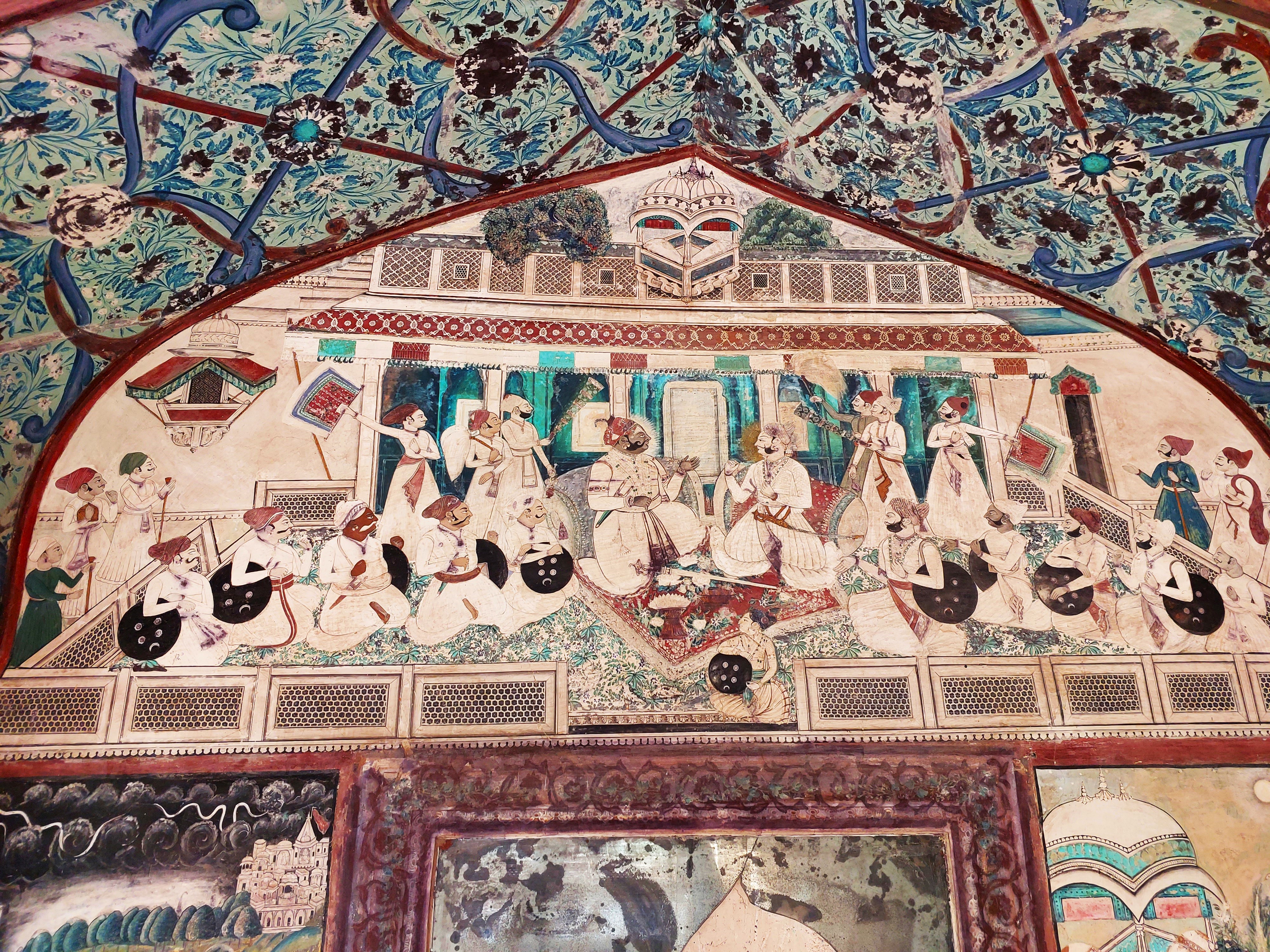
This style is a blend of vibrant and vivid colors with soft silhouettes. An influence of the Mughal style of paintings is also seen, especially, in the hunting and war scenes. A common theme seen in the miniatures is that the artists have captured several scenes within one miniature.
Ummed Mahal, ChitraShala also known as Rang Vilas
Chitra means painting and Shala means school – the birth place of the Bundi School of Art.
Curated by Ummed Singh, Rang Vilas literally means a room of color.
Why so many names for one room? After seeing the artwork in this room, I can bet, that an art connoisseur will provide several more names.
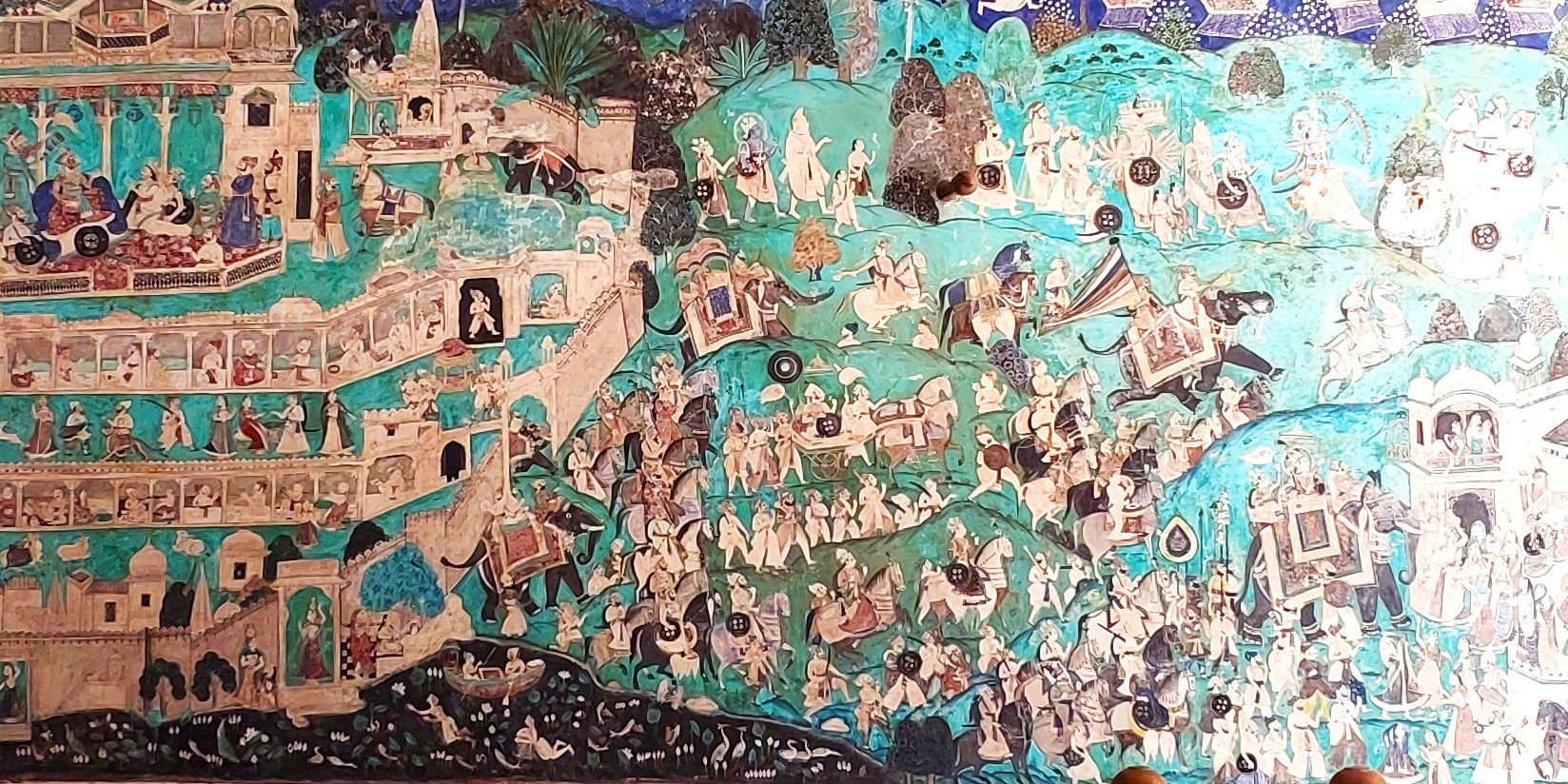
ChitraShala is covered from wall to ceiling with detailed miniatures and frescoes, in shades of turquoise, green and deep blues almost leaning into black. The ceilings are also, vibrantly painted with decorative motifs.
The room features running arches, pillars, and wooden doors. While the upper section of the walls are in the vibrant hues of blues, the lower walls are painted in shades of terracotta with decorative elephants and other motifs.
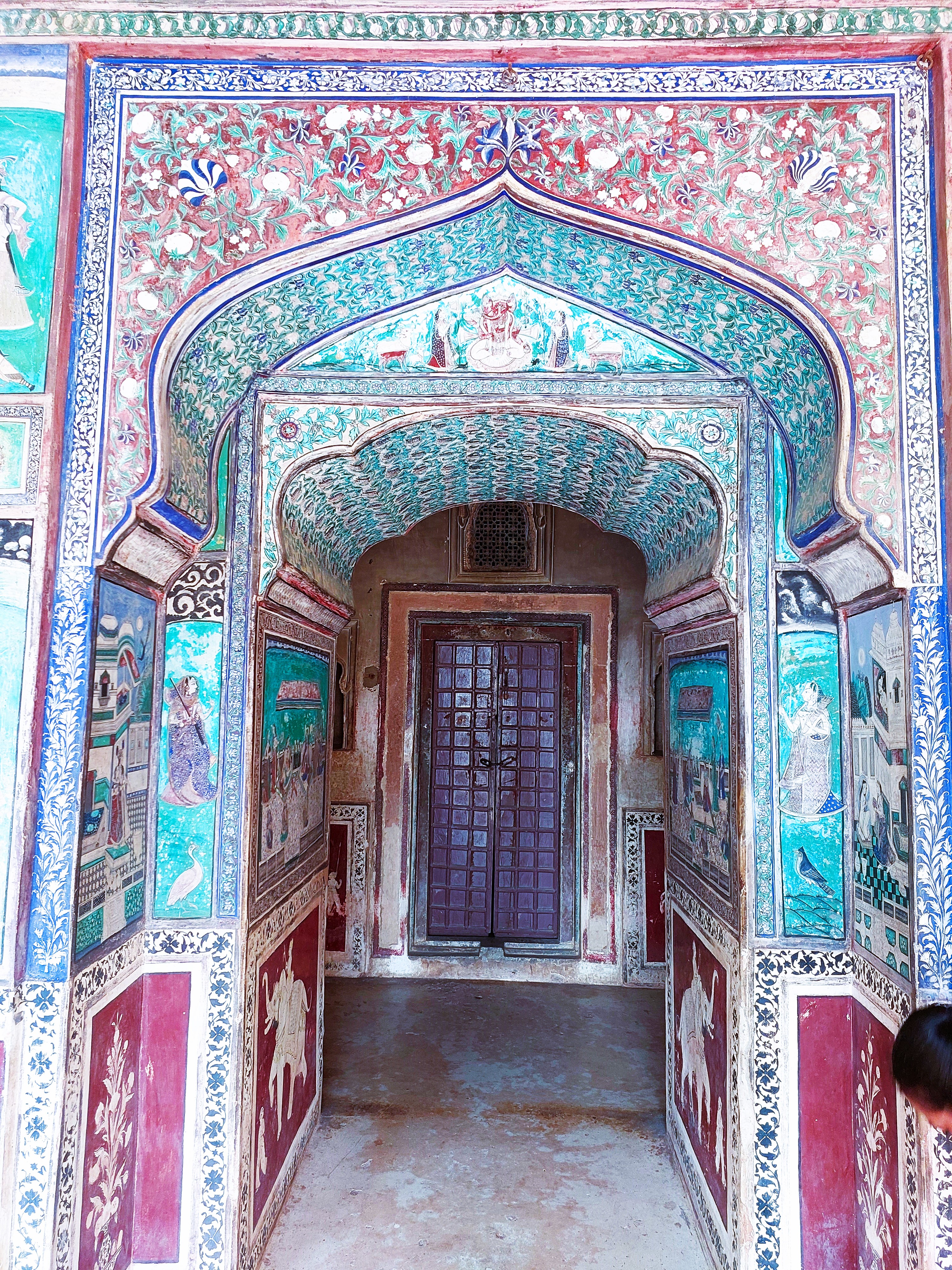
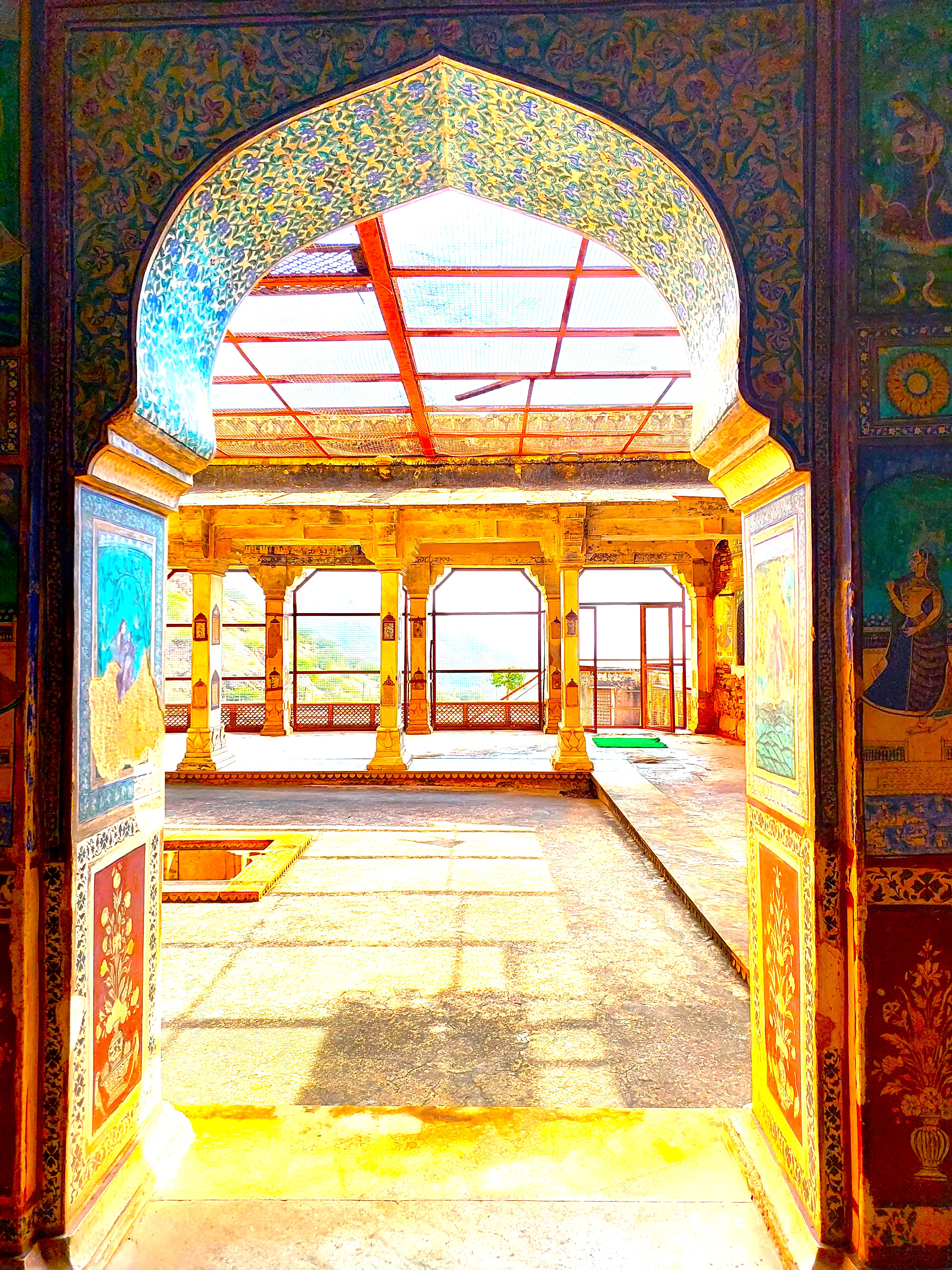
Scenes of war and hunting, kings and queens, lovers and friends are found on the walls. These scenes are interspersed with several scenes of the mythological Hindu god Krishna and his life.

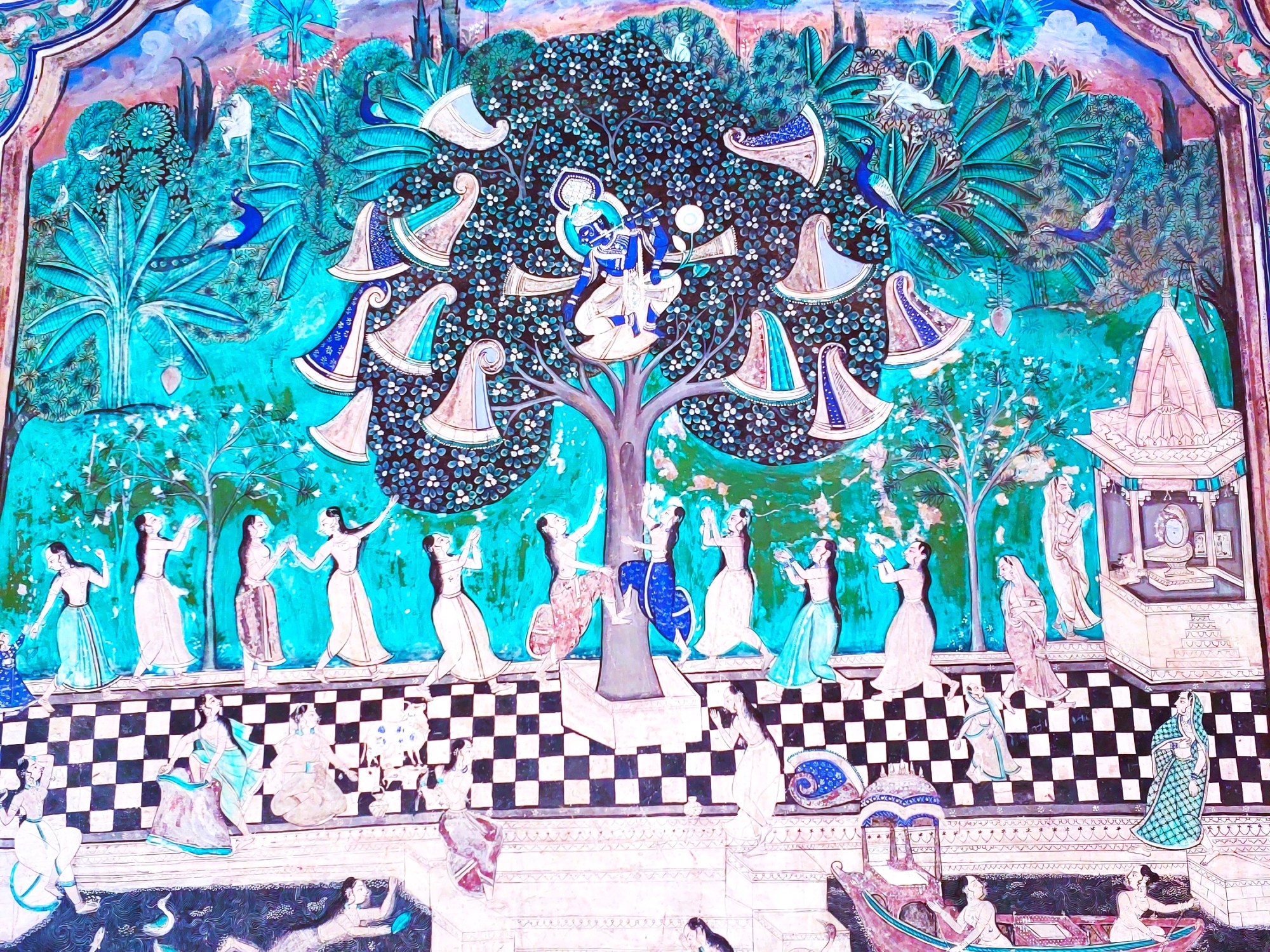
Interpretation of this fresco – Krishna has stolen the clothes of the gopis (cowherd girls and his devotees) and has climbed the treetop. The ladies are pleading to him, to give their clothes back. Details of the lotus flowers, fish, women in the boat or swimming are also added. Do you see the crocodile?
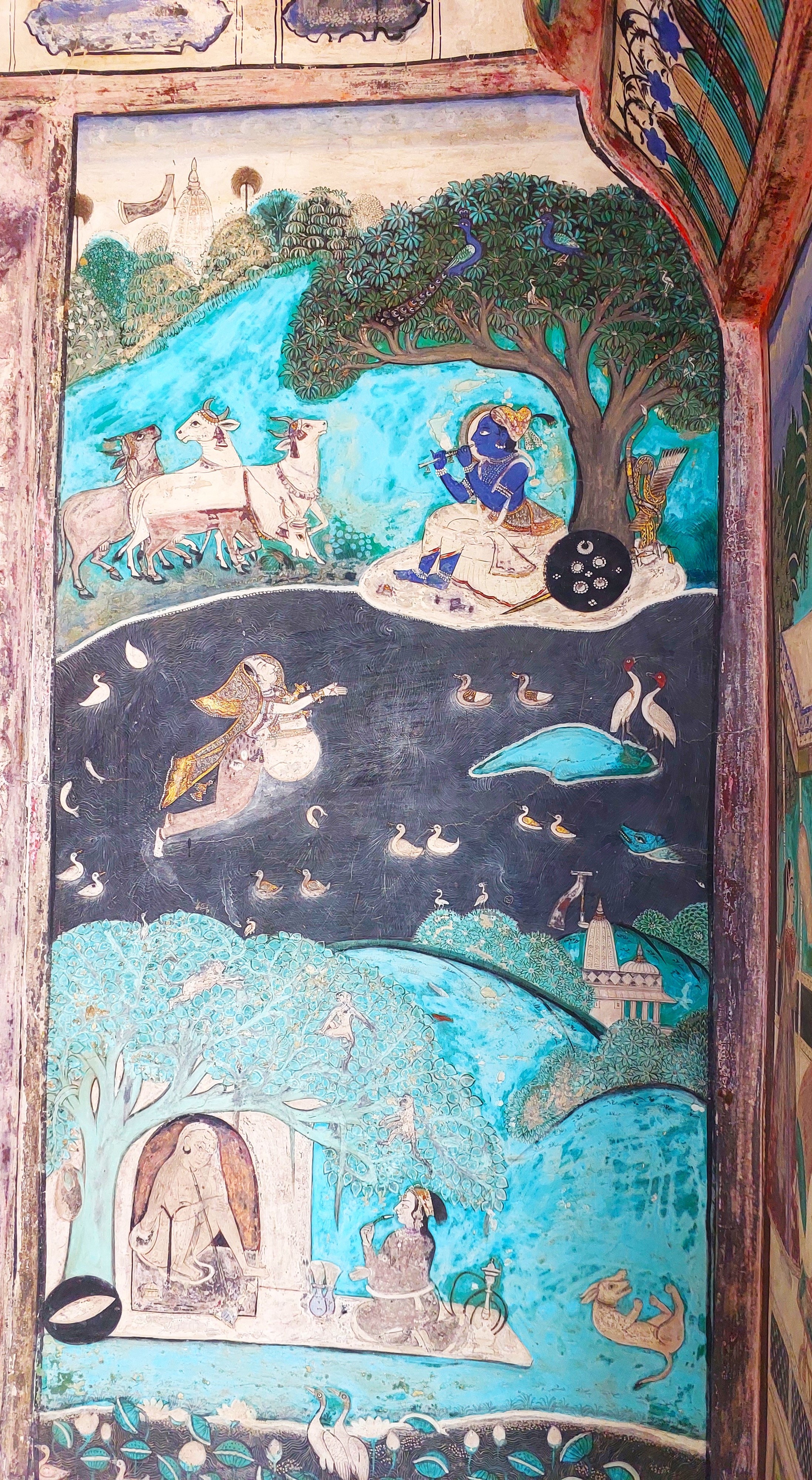
Interpretation of this fresco – Krishna is playing the flute which seems to have enchanted the cows, the peacocks, the ducks and the fish. A woman is swimming towards him. Can you see the crocodile?
Another scene in this miniature, is a holy person in his hut and a man with a hookah. Can you see the monkeys and an upturned dog?
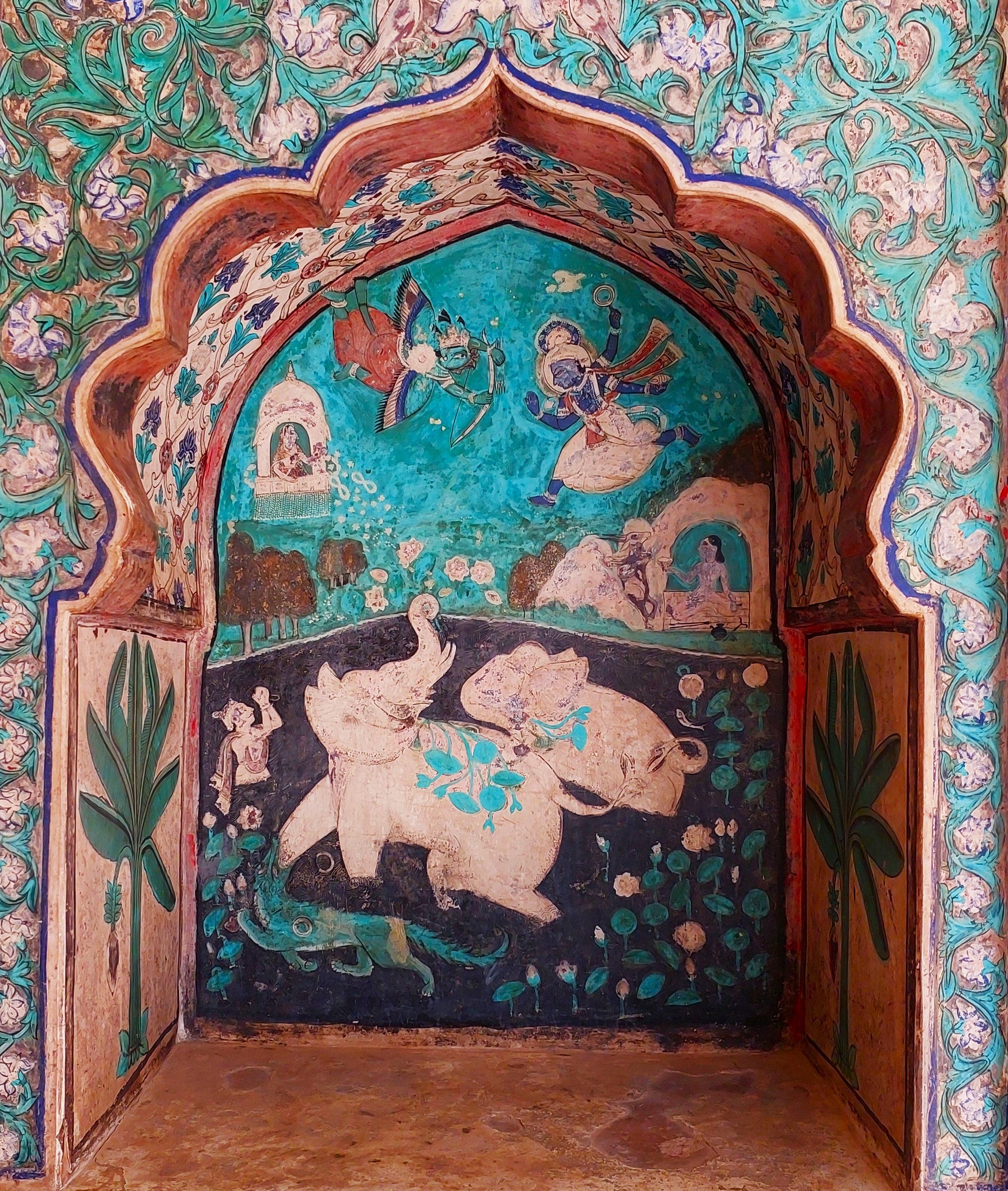
Interpretation of this fresco – There is a man praying next to the elephants. A holy man is meditating in a cave and is offering something to 2 goat like animals. A lady showering flowers. Krishna is seen with his celestial weapon, the Sudarshana Chakra (a divine spinning discus). He is in a fight in the skies, with the eagle headed god Garuda. Can you see the crocodile?
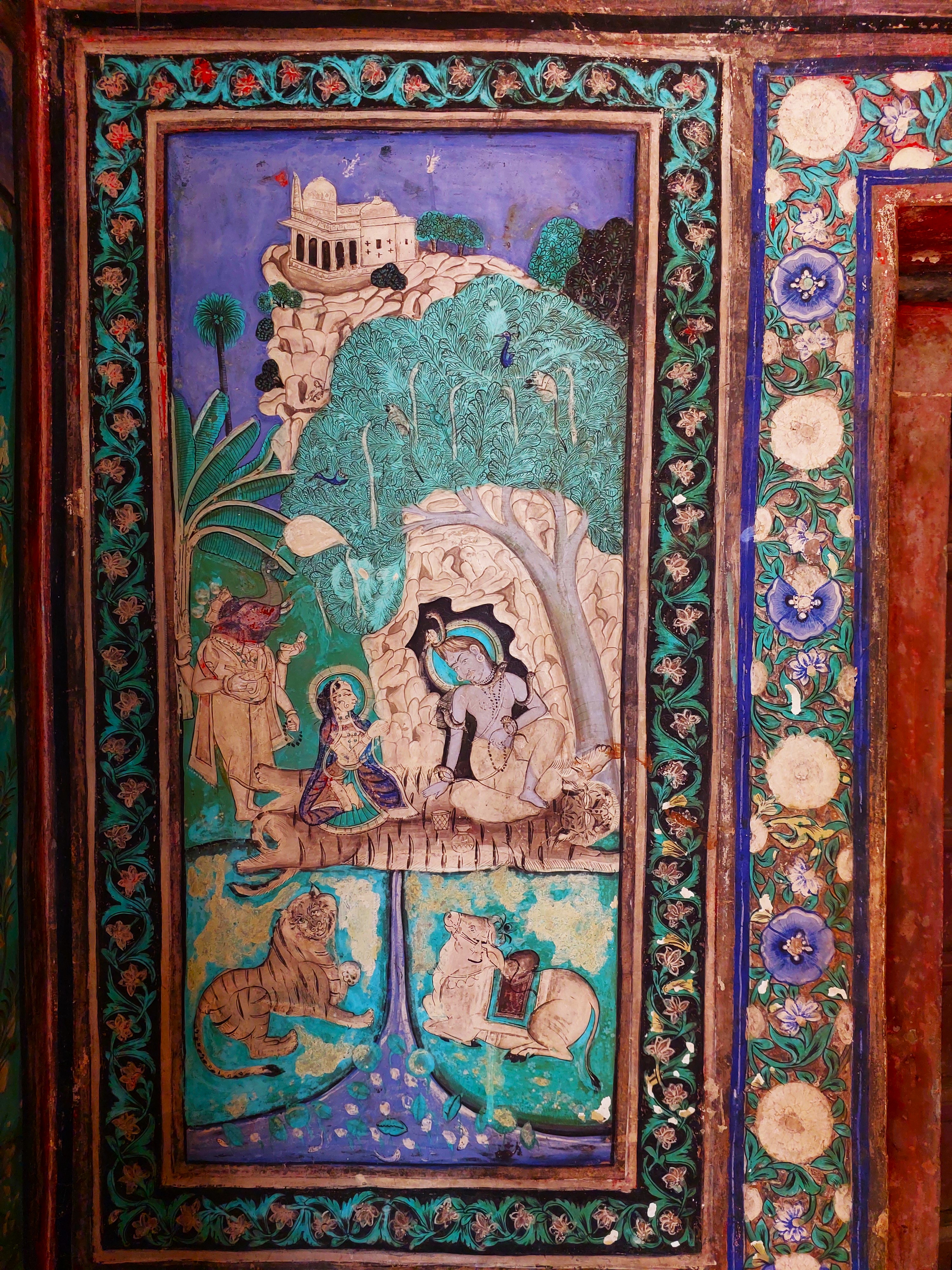
Interpretation of this fresco – this is a classic picture of Hindu god, Shiva with his wife Parvati seated on the skin of a tiger. His son the elephant headed god, Ganesh is standing nearby. There is a temple right at the top. The cow and tiger seem to be at the feet of Shiva. It seems that the tiger is smiling?
Each fresco is a mosaic of different scenes and each scene should be viewed individually and then as a whole.
Ummed Mahal is located on the lower level of the palace complex, and could be visited before Badal Mahal.
It allows the visitor to get a comprehensive and comparative overview of the type of artwork that was done in both the palaces – Ummed Mahal and Badal Mahal.
Badal Mahal – The Palace in the clouds
Badal Mahal has been named so, as it is located at the top of the palace.
The room is an explosion of red and gold. It felt at first glance, that we have walked into an Oriental room.
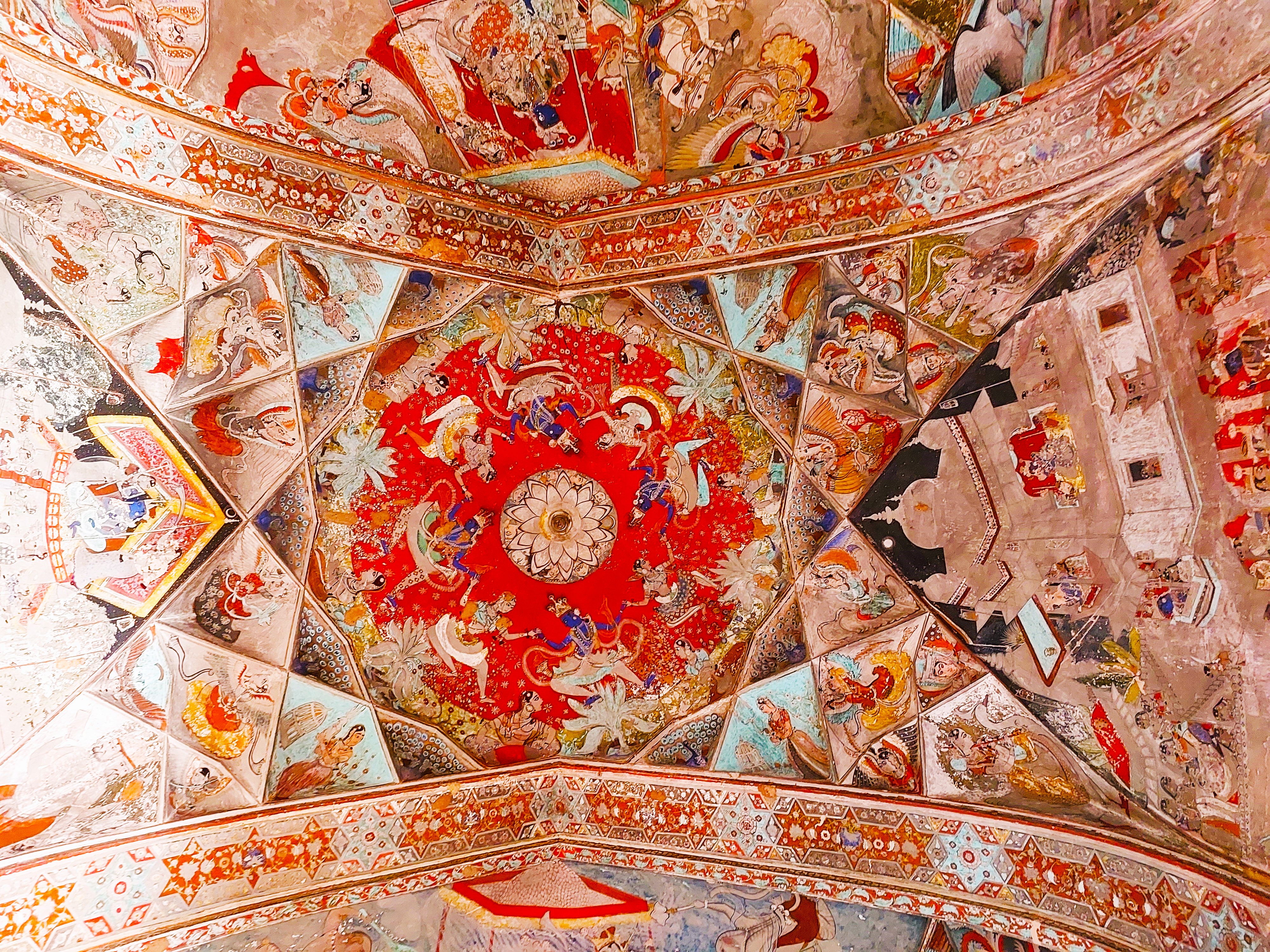
Interpretation of this fresco – Krishna, is performing the Raasleela or the cosmic dance. His divine partner Radha, the gopis (cowherd girls and his devotes) are seen in an ecstatic dance alongwith him. This scene is painted at the dome of the ceiling, making it the centerpiece of Badal Mahal.
Chitrashala has the fresco of Rasleela in the vivid colors of turquoise and blue, while the reds and gold of the Rasleela in Badal Mahal, give this painting a different dimension.
Several of the human figures in the frescoes have Chinese or Asian features. Flying dragons and mythical creatures are liberally painted on the windows, walls, and ceilings.

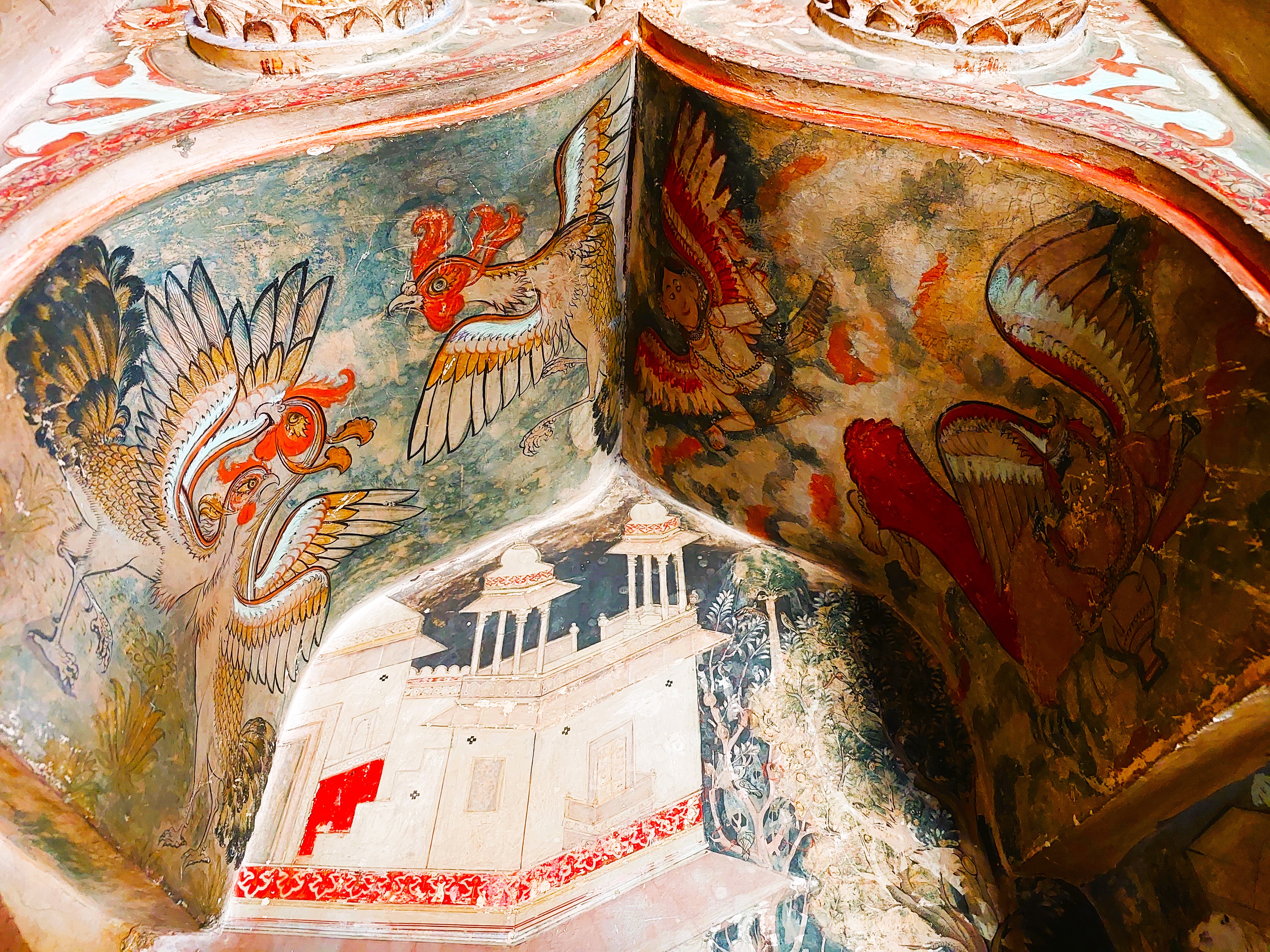
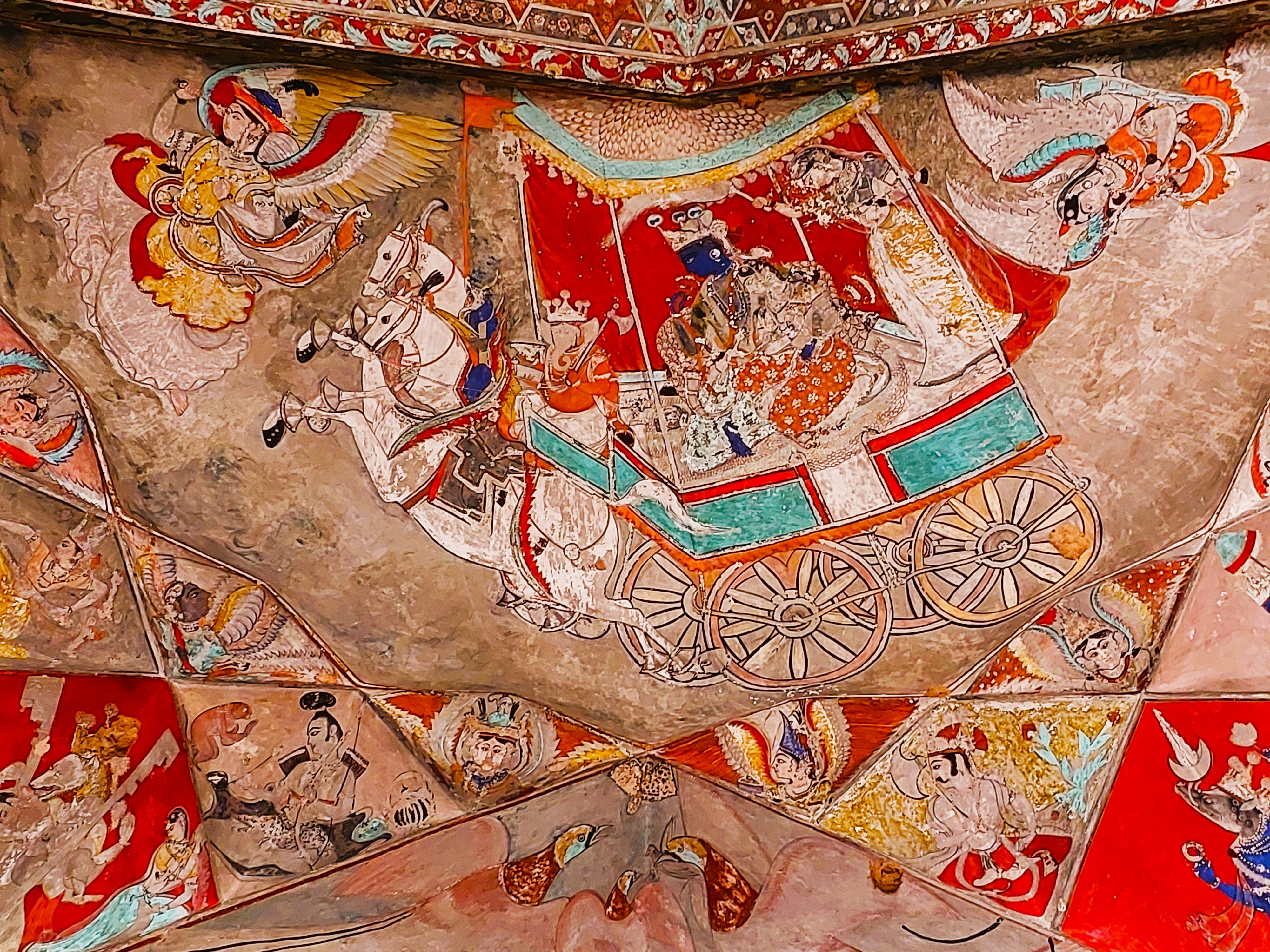
Interpretation of this fresco – Krishna’s marriage to Rukhmini, with Lord Ganesh as the charioteer. Celestial beings are accompanying them. To the left corner, is Lord Shiva with Oriental features.
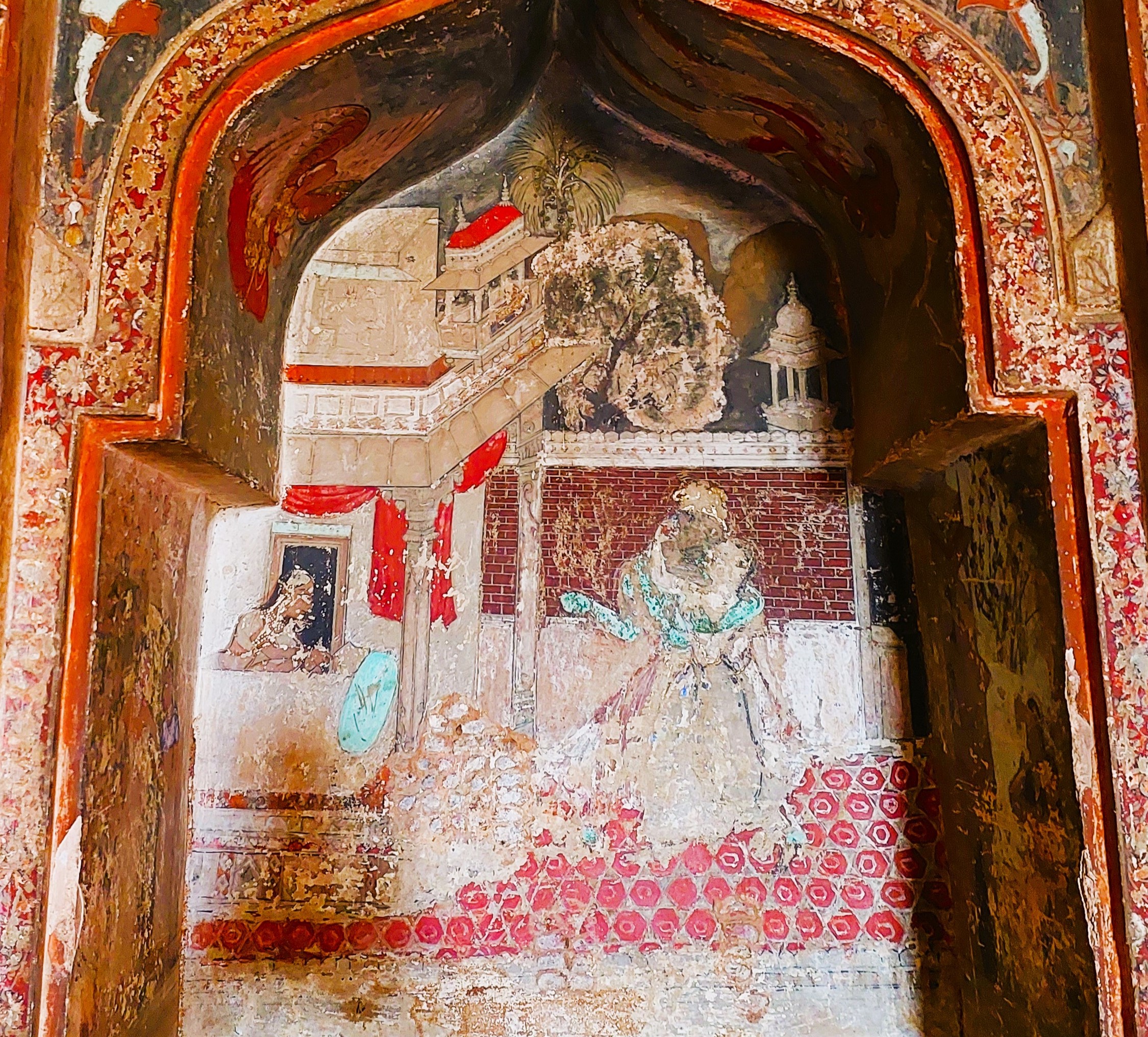
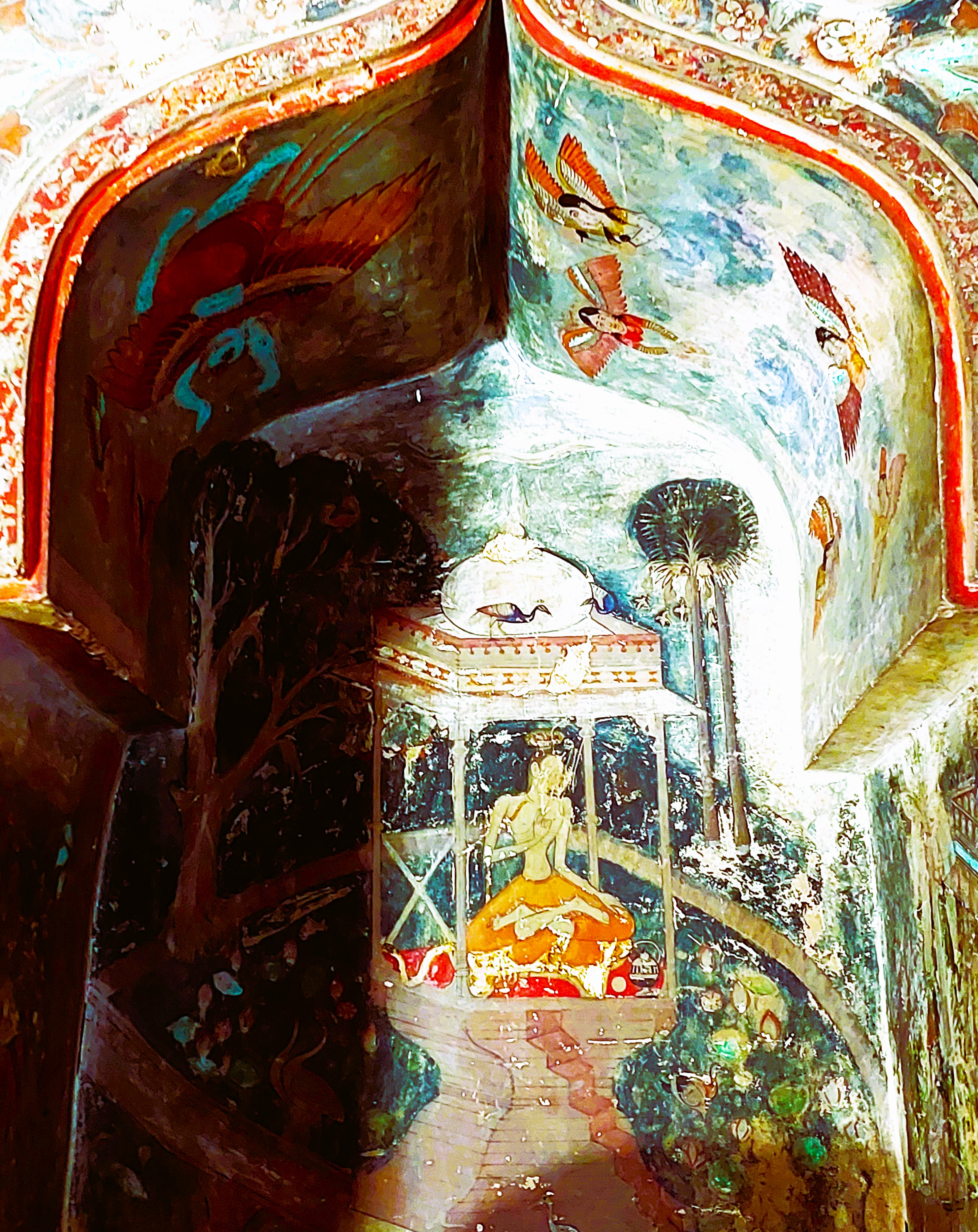
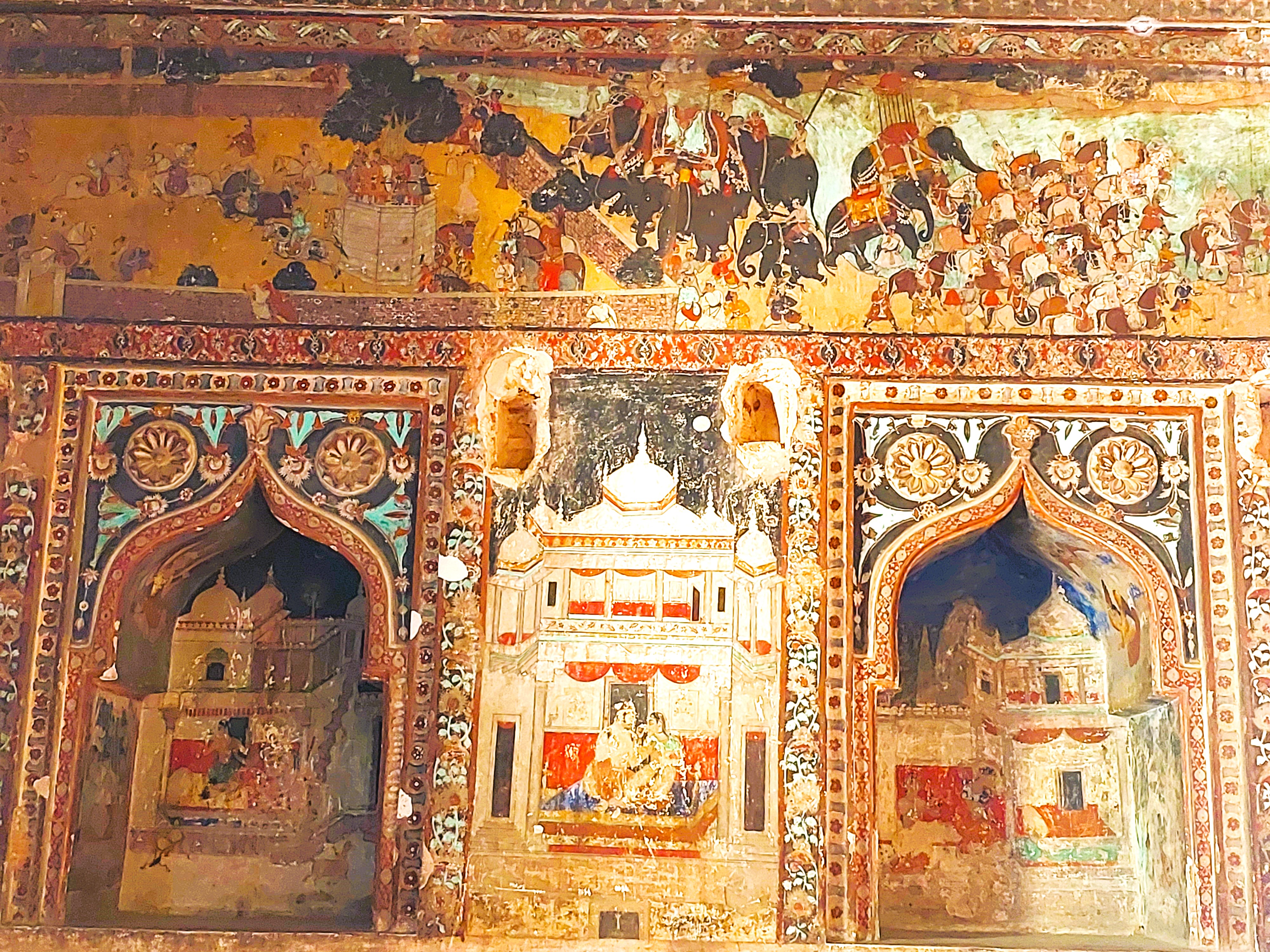
Ragmalas – These are frescoes painted in the niches of the room. Ragmalas are an expression of feelings and emotions through music. Love (divine and human), longing and passion are freely expressed in the ragamala paintings in Badal Mahal.
Each fresco is a mosaic of different scenes and each scene should be viewed individually and then as a whole.
Badal Mahal could be visited after ChitraShala, to get a comprehensive and comparative overview of the type of artwork that was done in both the palaces.
The rooms of Garh Palace are an artist’s wonderland. Many come here to study the frescoes, and perhaps be inspired to create similar works or art.
For travel details read my post linked above.

 The Smiling Travellerr
One thought on “An artistic exploration – Chitrashala and Badal Mahal”