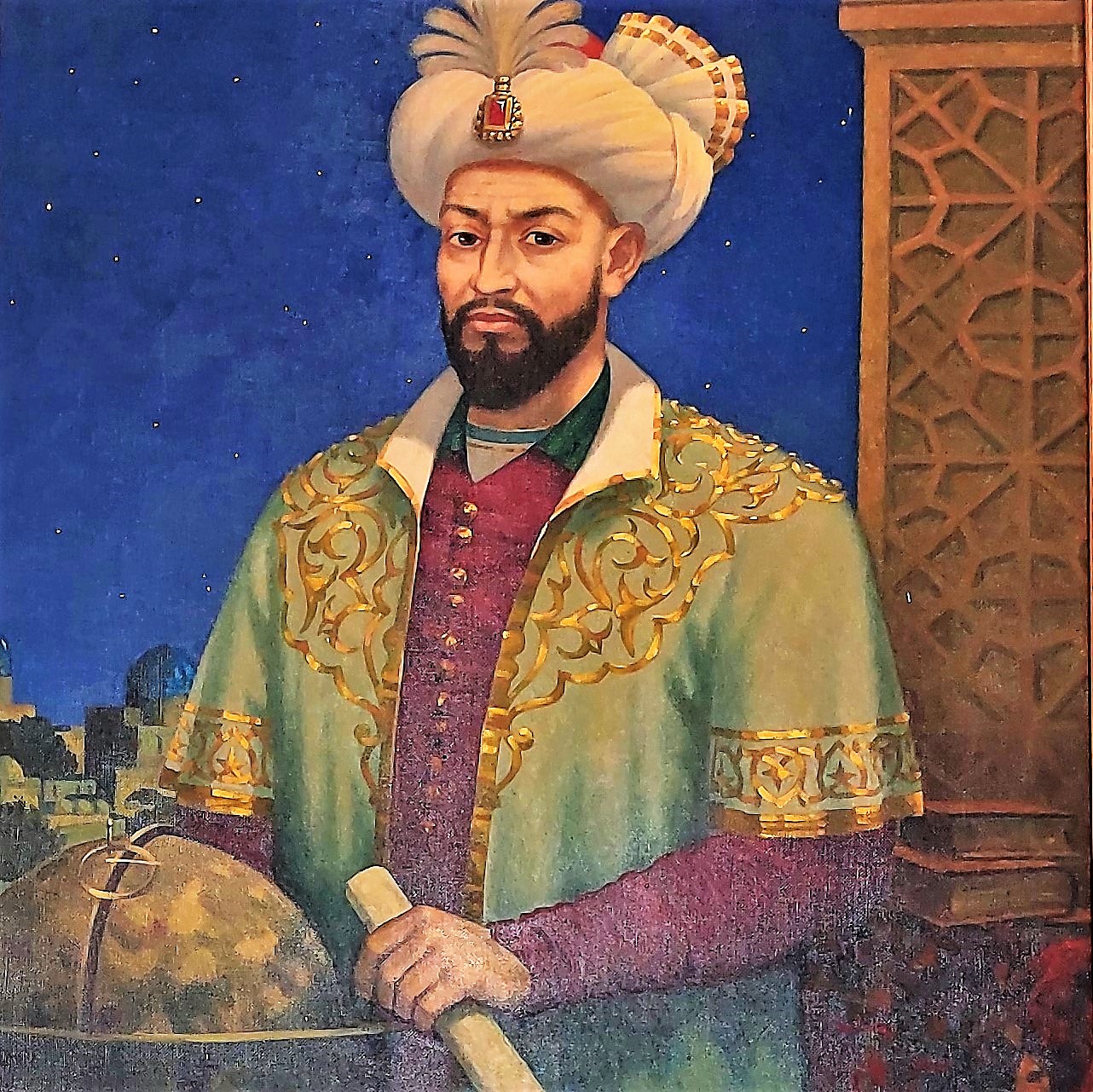
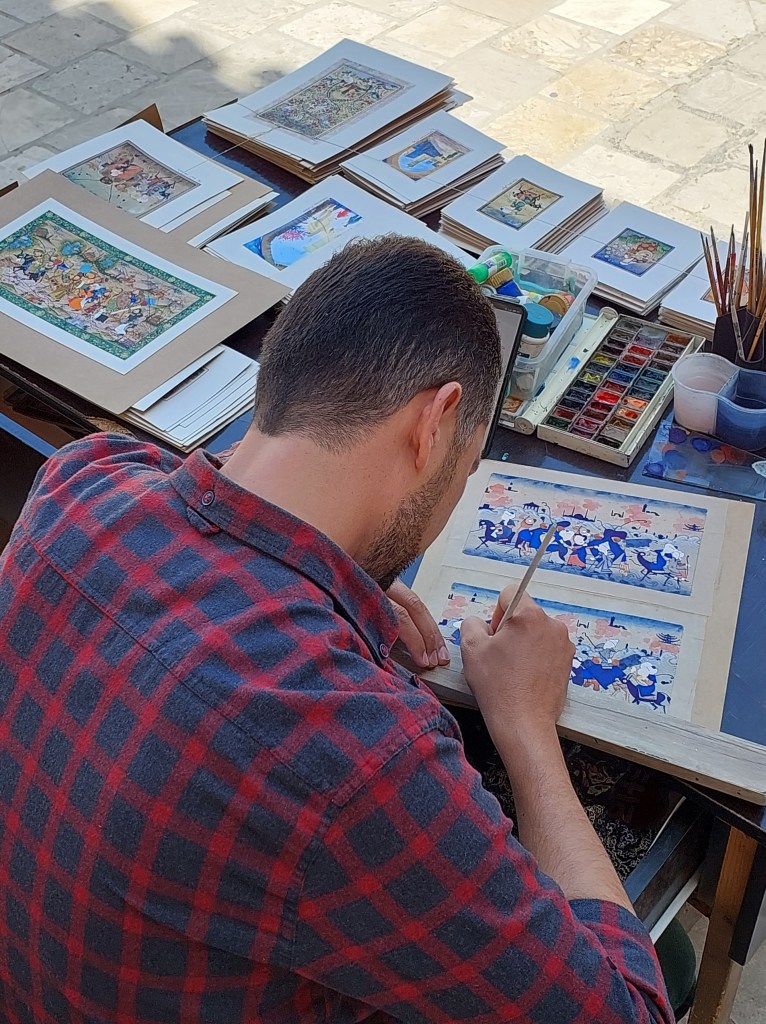
It was a bright sunny day in Bukhara. An artist was engrossed in creating a miniature painting. A palette of colors and several paint brushes lay strewn around. His work was displayed on a stand.
As I browsed through several works of art, an image in blue caught my eye. I immediately knew this is what I wanted.
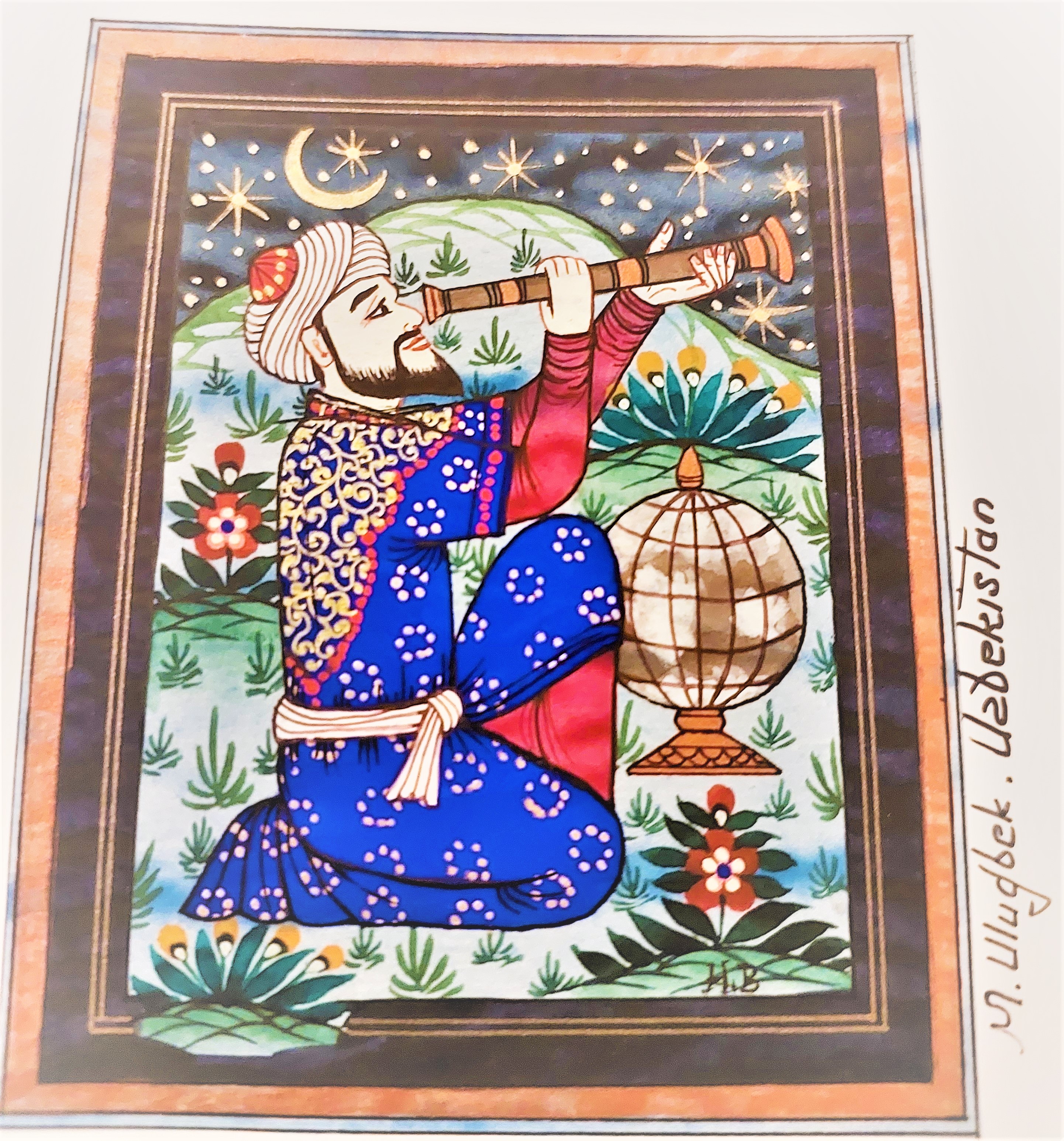
The words mentioned at the side ‘M. Ulugbek’ did not hold any meaning for me. But the painting of this fearless looking guy with a telescope chose me and I picked this miniature over the others.
The painting stayed deep in my backpack through my travels from Bukhara to Samarkand and I forgot about M. Ulugbek.
When in Samarkand, we were on our way to see an astronomical observatory and museum. Our guide made a mention that the observatory was constructed by Mirzo Muhammad ibn Shohrukh ibn Temur Ulugbek Koragon. That is when lightning struck.
Astonished, I reached into my backpack and pulled out the watercolor. This was ‘M. Ulugbek’ a well-respected and world-renowned astronomer, mathematician, poet, and painter.
I had instinctively picked the painting of M. Ulugbek over the others. Was the Universe trying to tell me something?
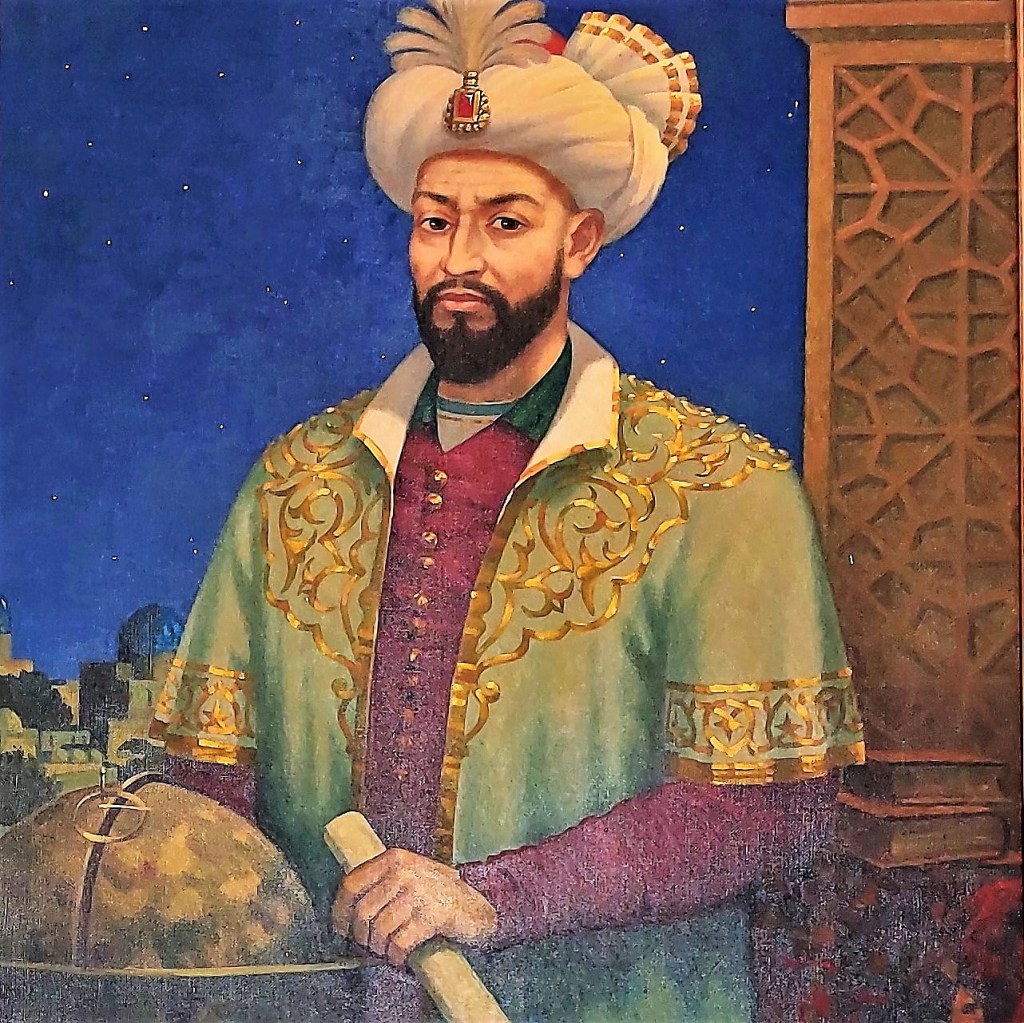
Mirzo Ulugbek, was the grandson of the well-known Central Asian ruler, Amir Timur. As Ulugbek was groomed to take on the throne, his grandfather also encouraged him to acquire knowledge in wide-ranging subjects.
Given the freedom to study, Ulugbek developed a passion for astronomy, mathematics, poetry, and arts.
In the ensuing years, along with his day job of being a powerful ruler in Central Asia, Ulugbek spent several nights studying the stars and its movements.
As he gazed into the vast unknown, was he ever torn between his passion and duty?
He would be a perfect addition to the star trek team along with Captain Kirk and Mr. Spock. I can imagine him, looking into his telescope watching the milky way and wishing to be beamed up (by Scotty).
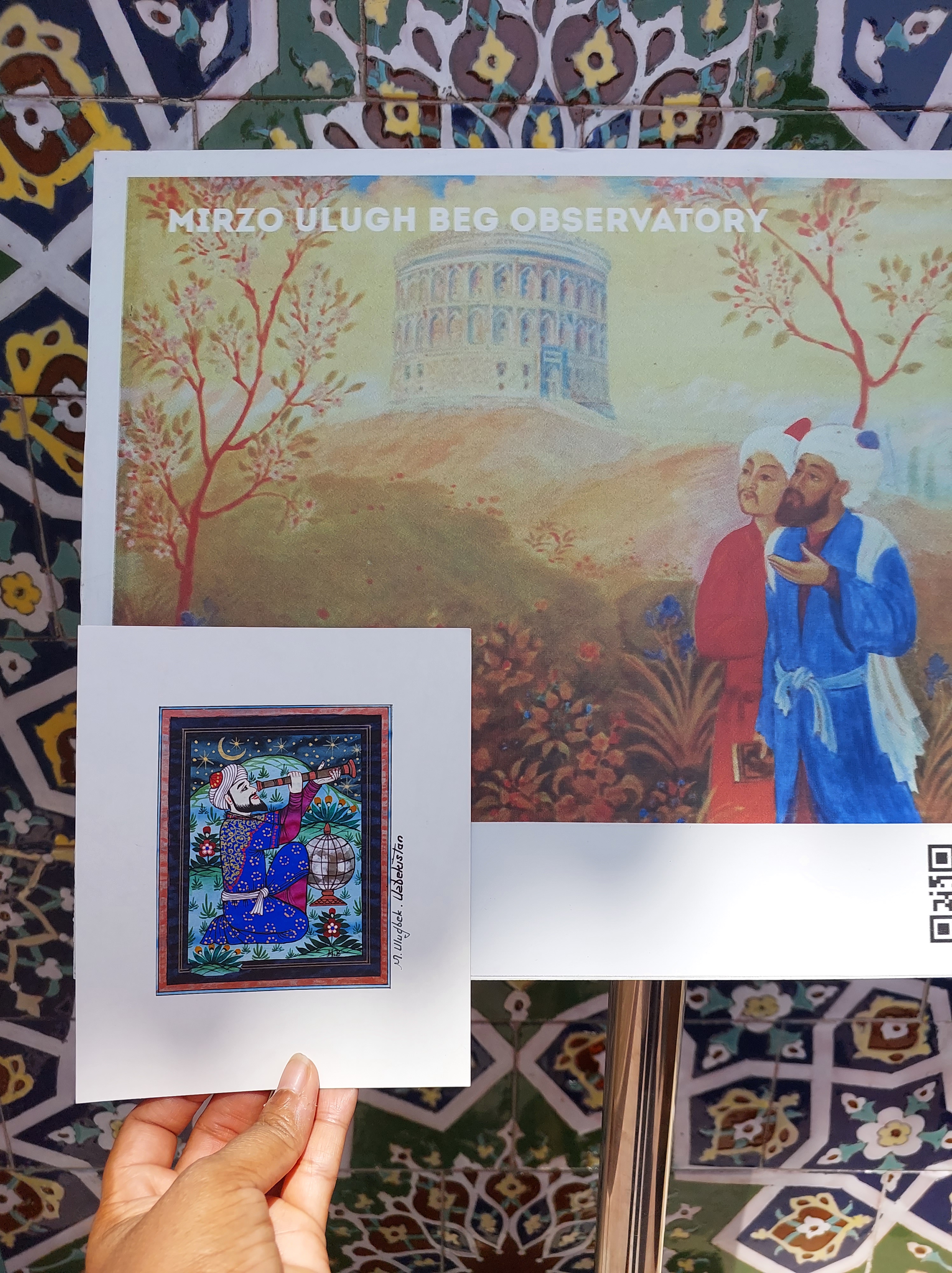
Determined to follow his passion for astronomy, Gurkhani Zij was constructed in Samarkand. The three-story observatory was a state-of-the-art building in its time.
While the observatory was being built, dissent was also building among the religious extremists.
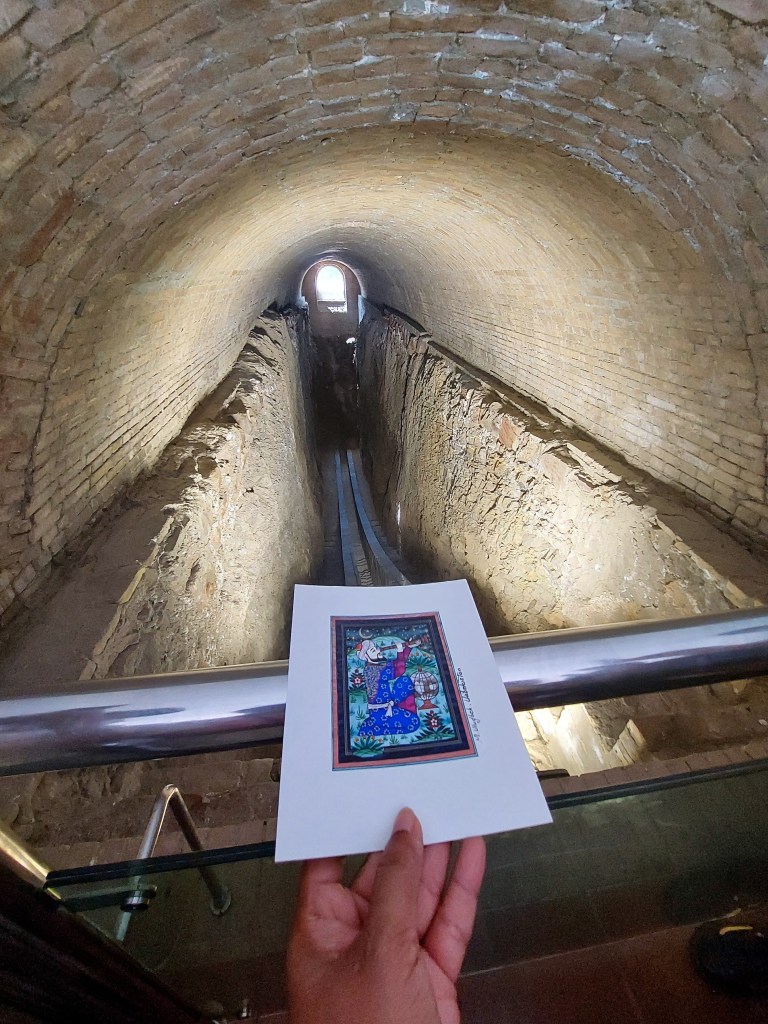
A deep trench with parallel brick bars was constructed.
This would be used for astronomical instruments required for deep space observations.
Ulugbek collaborated with astronomers from Central Asia and invited them to study the stars and its galaxies from the observatory.
He created a catalogue of approx. 1000 stars, which was used as a reference by astronomers from all over the world. His catalogue was called Zij-i-Sultani and could be considered his magnum opus.
Ulugbek wanted to pass on his love for knowledge and study to the people. He built madrassas (schools) in Bukhara and Samarkand. Islamic scholars and mathematicians were invited to come and study.
Eventually, Ulugbek’s revolutionary thinking and actions did not go down well with the orthodox and religious majority. They conspired with his son and assassinated him.
After Ulugbek’s death, the observatory was sadly destroyed, bringing an end to any further research and study of astronomy.
History has many instances where people who do not go mainstream are met with a similar fate. The ruins of the observatory and a museum built in Ulugbek’s honor can be visited, when in Samarkand.
To quote Captain Kirk’s words mentioned in every Star Trek episode – Ulugbek dared “To Boldly Go Where No Man Has Gone Before!“
“To Boldly Go Where No Man Has Gone Before!“

 The Smiling Travellerr